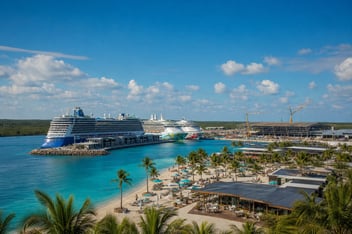
Grand Bahama recorded roughly 1.1 million visitors in 2025, its first year above one million in more than two decades. Almost all of the increase arrived by ship. For anyone underwriting rental income on the island, that distinction decides the model: a cruise call and an overnight stay produce entirely different cash flows for a residential owner. Rent is paid in nights, and nights come from air access.
Cruise volume and overnight demand are separate markets
Carnival's Celebration Key opened on Grand Bahama in July 2025 and reached approximately 2.4 million guests in its first year of operation. A pier expansion completed ahead of schedule doubled the berths from two to four. On Carnival's own figures, that adds around 200 vessel calls a year, lifts capacity above 13,000 guests per day, and unlocks some 700,000 additional annual arrivals to the island. Twenty Carnival ships currently call from ten US home ports, with Princess Cruises and AIDA joining the rotation during 2026. The destination represents a stated investment of about USD 600 million, and a Tourism Economics study cited by Carnival projects an annual GDP impact of USD 485 million and USD 160 million in additional annual tax revenue.
Those numbers are large and they are real. They are also day-trip numbers. A passenger who steps off a ship at a private destination, spends six hours ashore and sails the same evening contributes to port fees, employment and GDP. He does not occupy a bedroom, does not produce an average daily rate, and does not appear anywhere in a rental pro forma.
What the pass-through data actually shows
The gap between arrivals and island-wide spending is now being stated publicly by local business leaders. In October 2026, Grand Bahama Chamber of Commerce president Ralph Hepburn told The Tribune that an average of 7,000 passengers pass through Celebration Key, but that fewer than 1,000 typically leave the facility. He described Port Lucaya Marketplace, historically the island's main visitor retail and dining cluster, as "on life support" after the closure of one of its restaurants cost roughly 40 jobs.
Two readings follow, and a disciplined committee should hold both:
- The cautious read. A private cruise destination is designed to capture guest spend on site. Its passenger count is not a proxy for demand at Lucaya, Fortune Beach or anywhere else on the island, and a rental model that treats it as one is mispriced from the first line.
- The constructive read. The pass-through rate is a policy and commercial variable, not a fixed one. Shuttle arrangements, excursion contracting and marketplace investment can move it. But an investor is being asked to pay today for a conversion that has not yet happened.
Air arrivals and the one variable that matters
Air arrivals to Grand Bahama rose roughly 20% in 2025 against 2024 and sat more than 30% above 2019 levels, on Caribbean Journal's reporting; the Prime Minister cited air growth above 30% for 2025 against sea arrival growth above 90%. The series differ, but the ranking does not: sea arrivals are growing several times faster than air arrivals. Nationally, stopover arrivals for January to July 2026 came in at 1,314,639, up 4.3% year on year, with the Ministry of Tourism publishing island-level detail for Nassau, Exuma and Abaco but not for Grand Bahama.
The binding constraint is the terminal. Grand Bahama International Airport has operated from temporary facilities since Hurricane Dorian in 2019, and Phase One of the rebuild has now moved from planning to site work. Polycon has engaged Bahamas Hot Mix for preparation works; government statements put Phase One capital expenditure in the range of USD 100 to 130 million, partly from funds redirected from the Saudi Fund for Development; the design calls for a terminal handling up to 500,000 passengers a year, expandable to one million, with US pre-clearance, expanded apron and taxiway space, upgraded road access and flood mitigation. Manchester Airports Group has been contracted to manage the airport.
No completion date has been published. That is the single most important open item in any Grand Bahama rental model, and it belongs in the file as date risk rather than as an assumption. Pre-clearance in particular has to be re-certified, not simply switched on.
Room inventory is the other half of the equation
The second determinant of overnight demand is branded accommodation, because hotels buy airlift. The Grand Lucayan redevelopment has been announced as a USD 700 million project including a 550-room Hilton, with MSC Cruises and Concord Wilshire reported as progressing through approvals during 2026. MSC has separately outlined around USD 450 million at Freeport Harbour: approximately USD 400 million for port infrastructure including a new pier complex at the Billy Cay property, and USD 50 million for a beach club and retail village refurbishment.
Branded rooms cut both ways for a private owner. They add competing supply, but they also underwrite flight schedules and destination marketing. The historical pattern on Grand Bahama is instructive: private rentals performed worst not when the hotels were full, but when the hotels were closed, because the closures took the flights with them. Our Grand Bahama market overview sets out that infrastructure pipeline in more detail.
The cost side most rental models understate
Gross yield figures circulating for Bahamian rentals are frequently pre-tax, pre-licence and pre-insurance. The public framework imposes several items that belong in the net calculation:
- VAT on short lets. Vacation homes let for 45 days or less attract 10% VAT on all rentals by non-Bahamians, and bookings through online platforms are taxed at 10%. Foreign owners letting a vacation home must register for VAT, and returns fall due within 21 days of each period's end, with penalties for late filing and payment.
- Business licence. Since July 2023, foreign persons renting out property must hold a Bahamian business licence, with fees payable in quarterly instalments.
- Property tax treatment. A unit inside a rental pool or condo-hotel programme is assessed differently from an owner-occupied residence, and owner-occupier relief now requires at least 90 days of residence a year. The current rate structure for foreign owners is covered in our tax and residency guide.
- Insurance. Bahamian property premiums have risen by as much as 20% since 2022. For 2026, local underwriters indicated they expect to hold rates rather than reduce them, with reinsurance capacity rather than price the binding constraint.
- Acquisition cost. VAT on a transfer to a foreign person is 10% of the greater of price or market value, alongside a one-time USD 1,000 permit or registration fee under the International Persons Landholding Act.
An underwriting checklist for a rental-led purchase
- Model nights and average daily rate, never arrivals. Convert any arrivals figure into addressable overnight demand before it enters a spreadsheet.
- Separate the pier case from the airport case, and value them independently. The pier is operating; the airport is not.
- Stress the airport date. Test the model with Phase One completing one, two and three years later than hoped, and check whether the asset still clears its cost of capital.
- Verify the parcel's position inside or outside the Port Area, along with its utility and licensing status. Our Freeport free trade zone checklist lists the specific points to confirm.
- Build the model net: VAT, business licence, management fee, insurance, property tax, reserves and vacancy.
- Obtain a binding insurance quotation before the offer, not after due diligence.
- Define the exit. A rental-led asset on an island with one commercial airport has a buyer pool that moves with airlift.
Where this leaves a rental-led purchase
Grand Bahama's cruise infrastructure is already built and performing. Its overnight infrastructure is funded, contracted and under construction, but not yet delivered. An investor buying for rental income is therefore taking a timing position on the airport and the hotel pipeline, not a position on cruise volume. That can be a defensible trade at the right basis. It is not a defensible trade at a price that assumes 2.4 million cruise passengers are addressable demand.
If you are assessing a specific property on Grand Bahama and want the overnight-demand assumptions tested against the public data rather than against headline arrivals, we can review the underwriting with you. Accredited investors can request the current market file and property documentation below.
This article is for information only and is not investment, tax or legal advice. It is not an offer to sell or a solicitation of an offer to buy any security or any interest in any property. Figures cited are drawn from public sources and reflect those sources at the date of publication. Tax treatment depends on individual circumstances and must be confirmed with qualified advisors in the relevant jurisdictions.