

On 21 October 2026 Prime Minister Philip Davis announced a comprehensive review of the 1955 Hawksbill Creek Agreement, published a Green Paper titled "Grand Bahama: A Framework for Stability and Growth," and opened a six-month public consultation. For anyone underwriting Freeport Bahamas property, the question is no longer whether the legal framework is under review, but what the published timeline permits and what it leaves unresolved.
What the government announced on 21 October 2026
The announcement set out three elements. First, a review of the Hawksbill Creek Agreement directed by the Attorney General, which the Prime Minister said "will not be yet another review that results in maintaining the status quo." Second, a proposed Grand Bahama Development Act as a successor framework covering the whole island, delivered through negotiated amendments, targeted repeals and replacement provisions. Third, a Grand Bahama Development Council to coordinate development initiatives, monitor implementation and report to Cabinet.
Two statements bear directly on investor risk: changes would be made through Parliament, and nothing would be done retrospectively. The Prime Minister added that he would rather build Freeport's future with the Grand Bahama Port Authority's owners than around them, and that the Hayward and St George families could remain private investors through Port Group Ltd. The framing was governance rather than expropriation — "Public power belongs to the public," with no private institution holding a veto.
The timeline is published, and it is long
The dates define how long the framework stays unsettled:
- Formal consultation opened on 1 November 2026 and runs to 30 April 2027, with public meetings in Freeport, East Grand Bahama and West Grand Bahama.
- A White Paper is targeted for 1 July 2027.
- Draft legislation is targeted for 31 December 2027.
- Passage is targeted for the first quarter of 2028, with funding for the new framework in the 2028/2029 Budget.
On the government's own schedule, no statutory change takes effect before 2028. The Green Paper is published at gbframework.com. A buyer transacting in the next twelve months does so under the existing framework, with roughly fifteen months of consultation and drafting before any text is tabled.
What the Hawksbill Creek Agreement currently carries
The agreement was signed in 1955 and runs to 2054. It established Freeport's free trade zone model: duty-free treatment of imported inputs for licensees, and exemptions from business licence, property and capital gains taxation for licensed businesses within the Port Area. The Prime Minister acknowledged the 2054 end date explicitly and said that waiting for it was off the table.
He also said existing licences, approvals and concessions would be identified and their treatment addressed — a commitment to deal with legacy rights, not a statement of the outcome. Read it as an open item on the consultation agenda rather than a guarantee. The specific concession points worth checking are set out in Freeport Free Trade Zone: What Buyers Must Verify.
Where the two sides disagree
The Grand Bahama Port Authority responded on 23 October 2026 that its rights under the agreement "must be respected" and that any proposal to vary them "must be approached through agreement." It pointed to amendments agreed in 1960 and 1966 as evidence that the agreement was never intended to remain static, called the six-month window "ambitious," and noted that more than 3,500 licensees hold rights under the framework. Co-chair Sarah St George, whose family holds 50 percent of the GBPA, argued that Bahamian sovereignty and the agreement can coexist and called for "inventive interaction, not active intervention."
The government's position is that the agreement has outlived its utility and that parts should be replaced, reformed or repealed, and that no private consent is required to legislate. A 27 February 2026 arbitration award rejected the government's USD 357m claim against the GBPA, and the two sides disagree on what that award means for the Port Authority's regulatory role. Whether consent is legally required is the principal unresolved question, and one for counsel rather than market commentary.
The approvals data the Green Paper puts on the record
The most useful material in the Green Paper is operational rather than constitutional. It records permitted construction value rising from USD 66.758m in 2021 to USD 268.545m in 2024, while recorded starts moved only from USD 46.123m to USD 66.911m and completions from USD 42.447m to USD 43.726m. Starts were roughly 43 percent of permitted value in 2022 and 2023, and about 25 percent in 2024. The Green Paper itself cautions that permits, starts and completions can relate to different projects and years, so single-year totals should not be compared directly.
Reporting in October 2026 attributed part of the gap to a two-stop process: GBPA sign-off, then final approval from Nassau, with environmental approvals a common reason projects stall. Attorney Caitlin Antoni-Wilkinson of Cafferata & Co called for Grand Bahama-based officials with decision-making authority. For a private buyer, permission and schedule risk deserve more attention than headline concession risk.
What the consultation does not touch
Several items that drive a private purchase sit outside the Hawksbill Creek framework. The Bahamas levies no personal income tax, no capital gains tax and no inheritance tax. Freehold title is available to non-Bahamians, and conveyancing runs through Bahamian counsel in the ordinary way. Residency is governed by the Immigration Act, not by the agreement: for Freeport and the Grand Bahama special economic zone there is no minimum stay requirement, either for the Home Owner's Residence Card or for Permanent Residency. The 90 days frequently quoted refers to the Permanent Residency Certificate, which is issued once an applicant has been in the country for more than 90 days; it is a condition of issuance, not a presence obligation, and the certificate remains in force for life unless revoked under Section 18 of the Immigration Act. For other islands, including Nassau, readers should take advice from suitable counsel. The cost and document position is set out in Bahamas Permanent Residency: Costs & Requirements 2026.
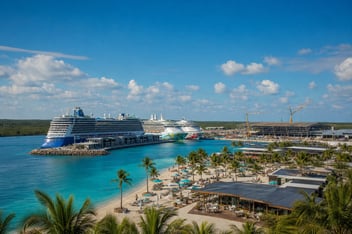
The capital expenditure behind the island's medium-term case is likewise independent of the review: MSC Cruises has a USD 450m project at Freeport Harbour, and the new Grand Bahama International Airport terminal targets an early 2029 completion. The build calendar is mapped against entry timing in Grand Bahama Property Investment: The 2027-2029 Window.
Underwriting a purchase during the consultation window
The reform changes the diligence list rather than the thesis. Five points belong in any Freeport underwriting before 2028:
- Separate licensee rights from owner rights. The duty and tax concessions under review attach to Port Area business licensees. A private residential purchase does not depend on them; a rental or development structure may.
- Price permission risk explicitly. If the asset requires construction or change of use, assume the two-stop approval path and build schedule contingency rather than relying on indicative timelines.
- Read proposals as proposals. Private submissions — including the reported 25-page "Freeport Transformation" paper proposing a Grand Bahama Economic Authority, 30-day deemed approvals and a 25-year guarantee of licensee rights — are consultation input, not policy.
- Document the framework in force at closing. Nothing is to be done retrospectively, so a contemporaneous record of concessions and approvals held at completion is how to rely on that.
- Follow the published milestones. The White Paper in July 2027 is the first point at which the government's intended direction becomes legible. Decisions that can wait for it reasonably should.
The review exists because the underlying problem is demographic: the island was planned for roughly 250,000 residents and had 46,740 at the 2022 census, down from 51,368 in 2010, with about one home in five vacant. A framework that delivers faster approvals and population growth would support property values; one that prolongs uncertainty would not. Which emerges is still open.
Discussing a Freeport position
If you are evaluating Grand Bahama during the consultation period and want the diligence framework applied to a specific asset or structure, we are happy to walk through it. Accredited investors can request our current Grand Bahama documentation using the form below.
This article is for information only and is not investment, tax or legal advice. It is not an offer to sell or a solicitation of an offer to buy any security or any interest in any property. Statements about pending legislation and consultation outcomes are descriptions of published proposals and positions, not predictions. Tax treatment depends on individual circumstances and must be confirmed with qualified advisors in your jurisdiction of residence.